
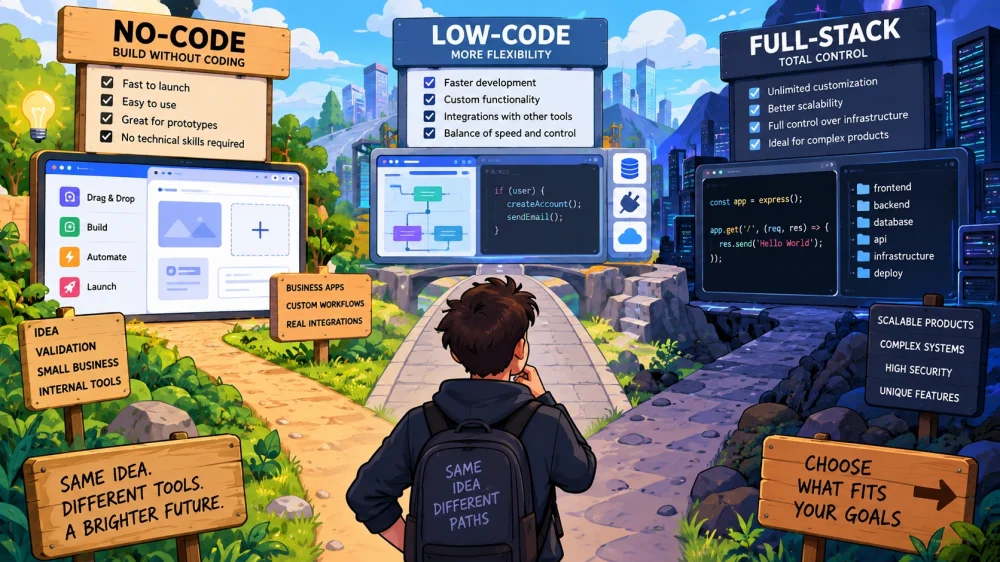
Turning an idea into a working digital product no longer automatically means hiring a team of developers and writing an application from scratch. No-code, low-code, and traditional full-stack development offer very different paths from concept to launch, and the fastest or most technically powerful option is not necessarily the best one. The right approach depends on product complexity, budget, scalability, integrations, security requirements, deadlines, and how much control the project will need in the future.
What no-code, low-code, and full-stack development actually mean
The main difference between no-code, low-code, and full-stack development is how much of the application’s underlying technology is controlled directly by the development team.
No-code platforms allow users to build websites, applications, databases, workflows, and internal tools primarily through visual interfaces. Instead of manually programming most functionality, creators connect predefined components, configure rules, and design workflows.
Low-code follows a similar principle but leaves more room for custom programming. Developers can use visual components for standard functionality while writing code for integrations, business logic, interfaces, or features that cannot be created efficiently with built-in tools.
Full-stack development gives a team direct control over the frontend, backend, databases, APIs, infrastructure, and application architecture. It usually requires more technical expertise and development time, but provides significantly greater freedom when building specialized software.
How the three development approaches compare
Choosing between these approaches involves balancing development speed against customization, technical control, scalability, and long-term maintenance.
- Development speed. No-code is generally the fastest for simple applications because much of the infrastructure already exists. Low-code adds development work but remains relatively fast, while custom full-stack projects usually require more time.
- Customization. No-code applications are limited by the capabilities provided by the platform. Low-code allows developers to extend those capabilities, while full-stack development provides the greatest freedom to create custom functionality.
- Technical expertise. No-code can be accessible to non-developers, whereas low-code often benefits from programming knowledge. Full-stack projects normally require professional software development skills.
- Scalability. All three approaches can support real products, but scaling becomes more dependent on the platform when using no-code or low-code systems. Custom architecture gives developers greater control over infrastructure and optimization.
- Cost. No-code can reduce initial development expenses, but platform subscriptions and usage charges may increase as a product grows. Full-stack development has higher initial costs but provides more control over long-term infrastructure decisions.
The comparison therefore cannot be reduced to which technology is “better.” A simple internal dashboard and a global real-time application have fundamentally different requirements and should not be evaluated using the same criteria.
When no-code is the most practical choice
No-code is particularly effective when speed, simplicity, and validation matter more than highly customized functionality.
A startup testing a business concept may not need a completely custom application. A functional prototype can demonstrate whether customers are interested before significant resources are committed to engineering. No-code can also work well for landing pages, directories, forms, simple customer portals, internal databases, approval systems, and workflow automation.
Another common use case is internal software. Companies often have processes that are too specific for generic software but too small to justify months of custom development. A no-code platform can bridge this gap by allowing teams to create purpose-built tools relatively quickly.
However, teams should examine platform limitations before building business-critical infrastructure around a no-code solution. The ability to export data, integrate external services, manage permissions, and migrate later can become important as the product evolves.
When low-code provides the right balance of speed and flexibility
Low-code becomes attractive when a project needs rapid development but also requires functionality that cannot be handled entirely through predefined visual components.
For example, a company may need a customer portal connected to an existing CRM, payment provider, analytics system, and proprietary database. Standard elements can be assembled visually while developers write custom logic for specialized integrations.
This hybrid approach can reduce repetitive engineering work. Developers do not necessarily need to build authentication screens, basic forms, dashboards, and administrative interfaces from zero if reliable components already exist.
Low-code is therefore particularly useful for business applications, operational dashboards, internal systems, prototypes that require real integrations, and products whose unique value comes from business logic rather than from highly specialized technical architecture.
When a project genuinely needs full-stack development
Full-stack development becomes necessary when the product requires extensive customization, specialized architecture, performance optimization, or direct control over its technical infrastructure.
Complex SaaS platforms, multiplayer systems, financial applications, large marketplaces, communication platforms, specialized AI products, and applications processing substantial amounts of real-time data may eventually exceed the practical boundaries of visual development platforms.
Custom development also becomes important when performance itself is a product requirement. Developers can optimize database queries, caching, network communication, background processing, frontend rendering, and infrastructure according to actual usage patterns.
Security and compliance requirements may provide another reason to choose a custom stack. Organizations can control where information is stored, how services communicate, which dependencies are used, and how access is managed instead of relying primarily on the architecture provided by a third-party platform.
The hidden limitations that can appear as a project grows
A platform that dramatically accelerates the first version of a product can create new constraints once traffic, data, integrations, and business requirements become more complex.
- Vendor lock-in. Application logic may depend heavily on proprietary platform features, making migration difficult or expensive.
- Pricing at scale. Subscription costs can change significantly when the number of users, workflows, database records, API requests, or automation operations increases.
- Performance limits. Developers may have limited ability to optimize the underlying infrastructure when performance bottlenecks appear.
- Integration constraints. A platform may support popular external services but provide fewer options for unusual APIs, legacy infrastructure, or custom protocols.
- Architecture limitations. Features that initially appear simple can eventually require background jobs, complex permissions, real-time processing, advanced databases, or specialized infrastructure.
These limitations do not mean that no-code or low-code should be avoided. They mean that the technology should match the expected lifecycle of the project. A tool that saves six months during validation may still be valuable even if the successful product is eventually rebuilt.
How to choose the right development path for your project
The decision should begin with product requirements rather than with a preferred technology or development trend.
- Define the core functionality. Separate essential product features from features that would simply be convenient to have.
- Estimate the expected scale. Consider the number of users, volume of data, frequency of transactions, and potential infrastructure requirements.
- Identify unusual requirements. Custom algorithms, complex integrations, real-time communication, advanced permissions, or strict security requirements can influence the development approach.
- Compare short-term and long-term costs. Include development expenses, subscriptions, infrastructure, maintenance, migrations, and the technical team required to operate the product.
- Plan for change. Consider what happens if the application becomes significantly more successful or complex than originally expected.
A small team validating an uncertain concept may prioritize launch speed and choose no-code. A company integrating several existing business systems may benefit from low-code. A team building technology whose competitive advantage depends on proprietary architecture may prefer full-stack development from the beginning.
Can you start with no-code or low-code and move to full-stack later
Starting with a simpler technology and rebuilding after validating the product can be a practical strategy, but migration should be considered before the first version is created.
A no-code prototype can help verify demand, test user behavior, refine workflows, and identify which features customers actually use. Once these assumptions have been tested, a development team has considerably more information for designing a custom system.
Migration is easier when data can be exported in standard formats and external services communicate through conventional APIs. It becomes harder when business logic, workflows, and databases are deeply tied to proprietary platform functionality.
Importantly, moving to full-stack does not always require replacing everything simultaneously. Teams can gradually move individual components to custom services while retaining low-code tools for administration, automation, content management, or other areas where they continue to work efficiently.
Which development approach makes sense for different types of projects
The best development model is the one that provides enough technical capability for the project without introducing unnecessary complexity, cost, or development time.
No-code is well suited to prototypes, landing pages, straightforward internal applications, directories, simple portals, forms, and early-stage product validation. Low-code is a stronger candidate for business applications, dashboards, workflow systems, customer portals, and products requiring a combination of standard functionality and custom integrations.
Full-stack development makes more sense when software itself is the core product and its competitive advantage depends on unique functionality, performance, scalability, security, or architecture.
The approaches can also coexist. A company might run its customer-facing application on a custom full-stack architecture while using low-code dashboards internally and no-code automation for routine business processes. Rather than treating no-code, low-code, and full-stack as competing philosophies, teams can view them as different levels of abstraction and choose the appropriate level for each part of the product.