
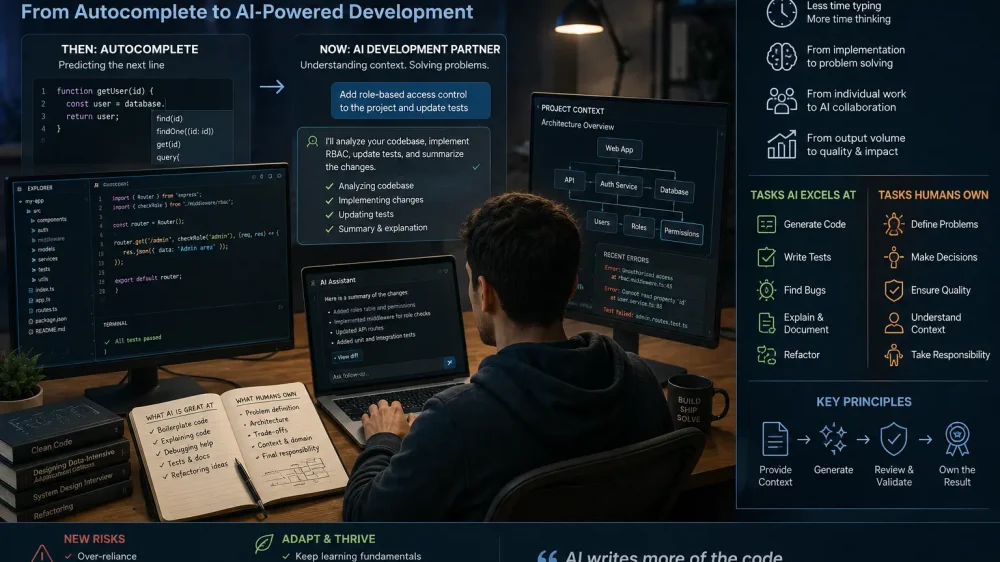
AI coding assistants have moved far beyond the autocomplete tools that initially impressed developers by predicting the next few lines of code. By 2026, they increasingly participate across the development workflow — exploring codebases, generating implementations, writing tests, debugging issues, explaining unfamiliar systems, and handling multi-step coding tasks. As a result, developers are spending less time producing routine code manually and more time defining problems, reviewing solutions, making architectural decisions, and deciding when AI-generated work can actually be trusted.
How AI coding assistants evolved into what they are in 2026
The biggest change in AI coding assistants is the transition from predicting code snippets to understanding broader development context and performing multi-step tasks across entire projects.
Early coding assistants were primarily sophisticated autocomplete systems. A developer would begin writing a function, and the model would suggest the next line, block, or implementation based on the surrounding code.
That was useful, but fundamentally limited.
Modern assistants operate at a much broader level. Instead of looking only at the currently opened file, they can work with information from multiple files, project structures, documentation, error messages, terminal output, tests, and development instructions.
This allows developers to describe objectives rather than individual lines of code.
Instead of manually implementing every component, a developer might ask an assistant to examine an existing authentication system, identify where a new permission should be introduced, implement the necessary changes, update tests, and explain what was modified.
This represents an important shift from code completion toward agent-like development workflows.
AI assistants are also increasingly integrated with the tools developers already use. Editors, terminals, repositories, issue trackers, documentation, and development environments can all become part of the context available to an assistant.
The result is not an autonomous replacement for software engineers.
It is a new development layer that can perform increasingly large portions of implementation while leaving developers responsible for defining requirements, evaluating trade-offs, validating results, and maintaining ownership of the final system.
Where AI assistants have changed developers’ daily workflow
AI is changing development less by eliminating individual jobs and more by reducing the amount of manual work required across many small tasks that previously consumed a developer’s day.
Some of the most noticeable changes include:
- Writing routine code. Boilerplate, data transformations, API integrations, configuration files, repetitive components, and standard CRUD operations can often be generated quickly, allowing developers to spend less time typing predictable implementations.
- Exploring unfamiliar codebases. Developers can ask questions about where functionality lives, how modules interact, what a particular class does, or which files are likely to be affected by a change instead of manually tracing every dependency from the beginning.
- Debugging. Error messages, stack traces, logs, and relevant code can be analyzed together. AI can suggest likely causes and possible fixes, reducing the time required to form an initial debugging hypothesis.
- Writing and maintaining tests. Assistants can generate unit tests, identify missing edge cases, update existing tests after implementation changes, and help interpret failures. Human review remains important because a test generated from incorrect assumptions can simply reinforce incorrect behavior.
- Documentation and code explanation. Developers can generate initial documentation, summarize pull requests, explain complex functions, and translate technical implementation details into descriptions understandable to other teams.
Individually, none of these changes necessarily transforms software development.
Together, however, they change where developer time goes.
The bottleneck increasingly shifts away from physically producing code and toward understanding what should be built, deciding whether an implementation is appropriate, and verifying that it behaves correctly under real conditions.
What tasks are shifting from developers to AI — and what isn’t
AI is taking over more implementation work, but responsibility for defining the problem, understanding the system, managing trade-offs, and accepting the consequences of technical decisions still belongs to people.
Routine and well-specified tasks are the easiest to delegate.
If an existing application already follows consistent patterns, generating another endpoint, component, migration, test suite, or integration can be relatively straightforward. The assistant has examples to follow and a clearly defined target.
The situation becomes more difficult when the problem itself is ambiguous.
Should the company build this feature at all?
Should data be stored centrally or distributed across services?
What happens when the system has ten times more users?
Which security risks are acceptable?
Is a technically elegant implementation worth the additional maintenance burden?
Questions like these require business context, organizational knowledge, engineering judgment, and an understanding of consequences that extend beyond the code itself.
AI can help analyze the options, but that is different from owning the decision.
The same applies to debugging.
An assistant may identify a failing query or race condition, but a developer still needs to understand whether the proposed fix merely hides the symptom or addresses the underlying architectural problem.
The division of labor is therefore becoming less about “AI writes code, humans do not.”
A more useful distinction is between execution and responsibility.
AI can increasingly execute technical work.
Developers remain responsible for whether that work should exist, whether it is correct, and whether it belongs in production.
How developers are adapting their process around AI assistants
Effective AI-assisted development requires developers to move from accepting generated code opportunistically to building a deliberate workflow around specification, generation, validation, and review.
A practical process increasingly looks like this:
- Define the task before generating code. Developers specify expected behavior, constraints, relevant architecture, interfaces, edge cases, and acceptance criteria. Better context reduces the likelihood that the assistant solves a slightly different problem from the one actually intended.
- Use AI to investigate before implementing. For unfamiliar or significant changes, the assistant can first analyze the relevant code and propose an implementation plan. Reviewing the plan is often cheaper than reviewing hundreds of lines of unnecessary generated code afterward.
- Generate changes in reviewable increments. Smaller modifications are easier to understand, test, and revert. Allowing an assistant to make an enormous cross-project change without checkpoints can create a review problem larger than the implementation problem it was meant to solve.
- Validate independently. Generated code should pass tests, static analysis, security checks, code review, and relevant manual validation. Developers should be able to explain important changes before treating them as production-ready.
This process changes the developer’s role.
Writing code remains important, but reading and evaluating code becomes even more important.
A developer who previously spent an hour implementing a feature may now spend fifteen minutes defining it, ten minutes generating an initial solution, and thirty minutes testing, reviewing, correcting, and simplifying that solution.
The total time may decrease substantially.
But the cognitive work has not disappeared.
It has moved.
New risks and skill gaps this shift is creating
The major risk of AI-assisted coding is not simply that models can produce incorrect code, but that developers can gradually lose the ability to recognize when generated code is incorrect.
AI-generated implementations can look convincing.
Functions are neatly structured. Variable names appear reasonable. Comments sound confident. Tests may even pass.
Yet the code can still contain incorrect assumptions, subtle security vulnerabilities, inefficient queries, concurrency problems, unnecessary abstractions, or edge cases that were never considered.
This creates a verification problem.
As the volume of generated code increases, developers can produce changes faster than they can deeply review them.
That can lead to what might be called comprehension debt: a growing amount of code that exists inside the system but is not fully understood by the people responsible for maintaining it.
Junior developers may face a particularly complicated trade-off.
AI can dramatically accelerate learning by explaining unfamiliar concepts, generating examples, and providing immediate assistance. At the same time, relying on it too early can allow developers to bypass the difficult problem-solving experiences through which engineering intuition is normally developed.
Security and ownership create additional concerns.
Developers need to understand what information can safely be provided to external AI systems, how generated code is handled within company policies, and which tools are permitted to interact with proprietary repositories or sensitive data.
There is also the risk of homogenization.
If teams continuously accept conventional AI-generated solutions without questioning them, codebases may accumulate generic patterns that technically work but do not necessarily fit the specific architecture or requirements of the organization.
AI therefore raises the value of engineering judgment rather than eliminating it.
How developers can use AI assistants without losing core skills
The most sustainable approach is to use AI to reduce mechanical work while deliberately preserving the skills required to understand systems, solve unfamiliar problems, and evaluate technical decisions independently.
One useful rule is simple: do not merge important code you cannot explain.
A developer does not need to manually write every line, but should understand what significant generated code does, why the implementation was chosen, what assumptions it makes, and where it could fail.
Developers should also continue solving some problems without immediate AI assistance.
Debugging an unfamiliar failure manually, designing a data model from first principles, reading documentation directly, or implementing an algorithm independently may take longer, but these activities maintain the mental models needed to evaluate AI output later.
AI can then be used as a second opinion rather than a substitute for understanding.
Another useful practice is to ask assistants for reasoning around alternatives rather than immediately requesting implementation.
Ask what approaches are possible.
Ask about trade-offs.
Ask what could go wrong.
Ask which assumptions should be validated before coding.
This turns the assistant into a tool for expanding technical analysis rather than merely producing more code.
Fundamentals remain important for the same reason calculators did not eliminate the need to understand mathematics.
Developers still benefit from understanding data structures, databases, networking, operating systems, security, concurrency, testing, architecture, and the behavior of the languages and frameworks they use.
These skills determine whether someone can distinguish a strong generated solution from one that merely looks plausible.
The competitive advantage of developers in 2026 is therefore unlikely to come from either extreme.
Refusing AI assistance entirely can mean spending valuable time on work that can now be automated efficiently. Blindly delegating everything to AI can produce fast output without the understanding required to maintain reliable systems.
The stronger position lies between them.
Developers can allow AI to handle more repetitive implementation, exploration, documentation, testing, and initial debugging while investing their own attention in requirements, architecture, security, verification, product understanding, and difficult technical decisions.
As coding itself becomes cheaper, judgment becomes more valuable.
The developer’s job is not disappearing simply because more code can be generated automatically. It is shifting from being primarily the person who produces every instruction manually toward being the person who understands the system well enough to decide what should be built, guide how it is built, and take responsibility for whether the result actually works.